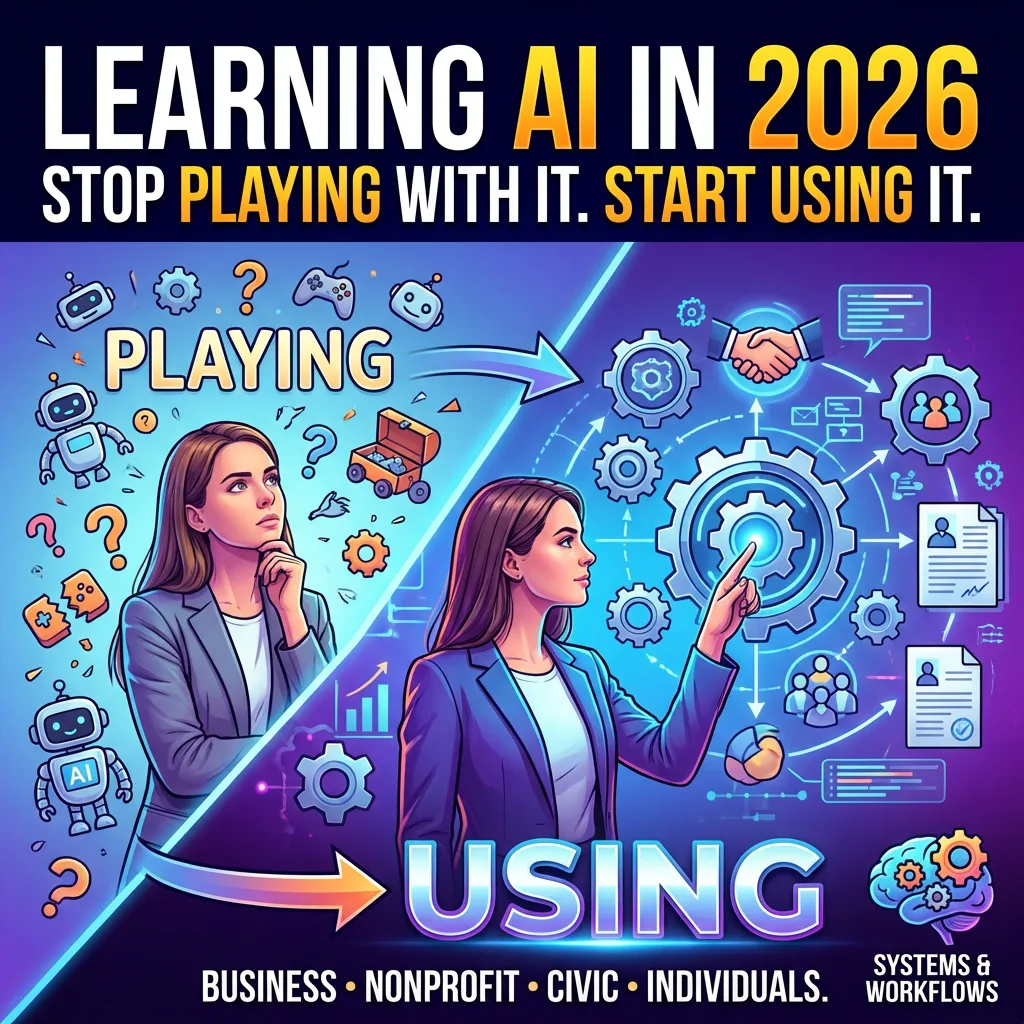
Learning AI in 2026: Stop Playing With It. Start Using It.

Description
“Learning AI in 2026: Stop Playing With It. Start Using It.” explains the shift from casual experimentation with artificial intelligence to intentional, practical implementation. The article argues that the real value of AI comes not from novelty uses like generating content, but from applying it to solve real problems and build repeatable workflows. It introduces a simple three-step framework to help individuals and organizations move from AI beginners to AI practitioners.
Summary
The article emphasizes that learning AI in 2026 requires a mindset change. Instead of treating AI like a curiosity or trivia tool, users should apply it as an analytical and operational assistant. The key transition happens when people stop asking AI only for outputs and begin collaborating with it to analyze problems, identify patterns, and build repeatable systems.
To accomplish this, the article introduces a practical three-step process: identify a real friction point, use AI for analysis rather than simple production, and create a repeatable workflow that improves over time. By following this structured approach, individuals and organizations can turn AI from an interesting tool into a consistent capability multiplier.
Quick Overview
Main Idea: AI’s true value comes from building systems and workflows, not generating one-off outputs.
Audience: Businesses, nonprofits, civic groups, and individuals seeking practical AI use.
Core Framework: Identify problems → Use AI for analysis → Build repeatable workflows.
Key Insight: Practitioners collaborate with AI to solve problems and improve processes.
Outcome: AI becomes operational leverage rather than a novelty.
Key Points
The Mindset Shift in AI Learning
Beginners treat AI like a tool for quick answers.
Practitioners use AI to analyze patterns, evaluate ideas, and improve processes.
AI Is Useful Far Beyond Business
Applications include churches, civic organizations, sports leagues, event planning, nonprofits, and personal productivity.
Any structured activity can benefit from AI-assisted analysis and organization.
The 3-Step Plan for Learning AI in 2026
Step 1: Identify a friction point or recurring problem.
Step 2: Ask AI to analyze data and propose solutions rather than simply generate content.
Step 3: Build one repeatable workflow that can be refined over time.
Practical Weekly Implementation Model
Monday: Identify a bottleneck.
Tuesday: Provide data to AI.
Wednesday: Request analysis and solutions.
Thursday: Implement a test version.
Friday: Measure and refine.
Common Mistakes to Avoid
Jumping between tools without building processes.
Expecting perfect results immediately.
Providing insufficient context.
Failing to measure outcomes.
Limiting AI to content creation tasks.
Important Details & Evidence
The article demonstrates practical use cases for AI across multiple domains:
Churches: Sermon preparation, attendance analysis, youth engagement.
Sports leagues: Scheduling optimization and communication with parents.
Civic organizations: Volunteer coordination and event promotion.
Wedding planning: Vendor comparison and budget analysis.
Small businesses: Lead management, content workflows, and customer service automation.
It highlights that AI functions as a pattern recognition engine, meaning its usefulness increases when users provide structured data and clear problems.
The article stresses that the transition to effective AI use occurs when individuals build repeatable workflows, not when they simply generate occasional outputs.
Final Takeaways
AI learning in 2026 is about practical application, not experimentation.
The most valuable skill is problem definition and workflow design, not tool mastery.
Real productivity gains come from repeatable AI-assisted systems, not one-time prompts.
Anyone—from business leaders to volunteers—
🎙️ Presented by E Internet Marketing Services, helping small businesses thrive in the age of intelligent technology.
👉 Learn more about Voice AI Plus: https://einternetmarketingservices.com/voice-ai-learn-more/
💡 This podcast series is inspired by the book, AI for Beginners Demystified
Enjoy the Book Summary (PDF) HERE
Visit the Author's Page: https://ricksamara.com
Get the Book on Amazon: https://www.amazon.com/dp/B0FM47NKPX
Visit the Official Information Page: https://aiforbeginners.einternetmarketingservices.com/home
Ready to explore Galaxy AI? https://galaxy.ai/?ref=richard0z
Let's connect!
Facebook: https://www.facebook.com/eInternetMarketingServices
Website: https://einternetmarketingservices.com
👍 Like this podcast? Give it a thumbs up and share it with your network if you found it helpful!
➡️ Want to learn more? Subscribe to our channel for more AI insights, practical tips and tutorials!
💬 Share this podcast with your fellow AI enthusiasts!
