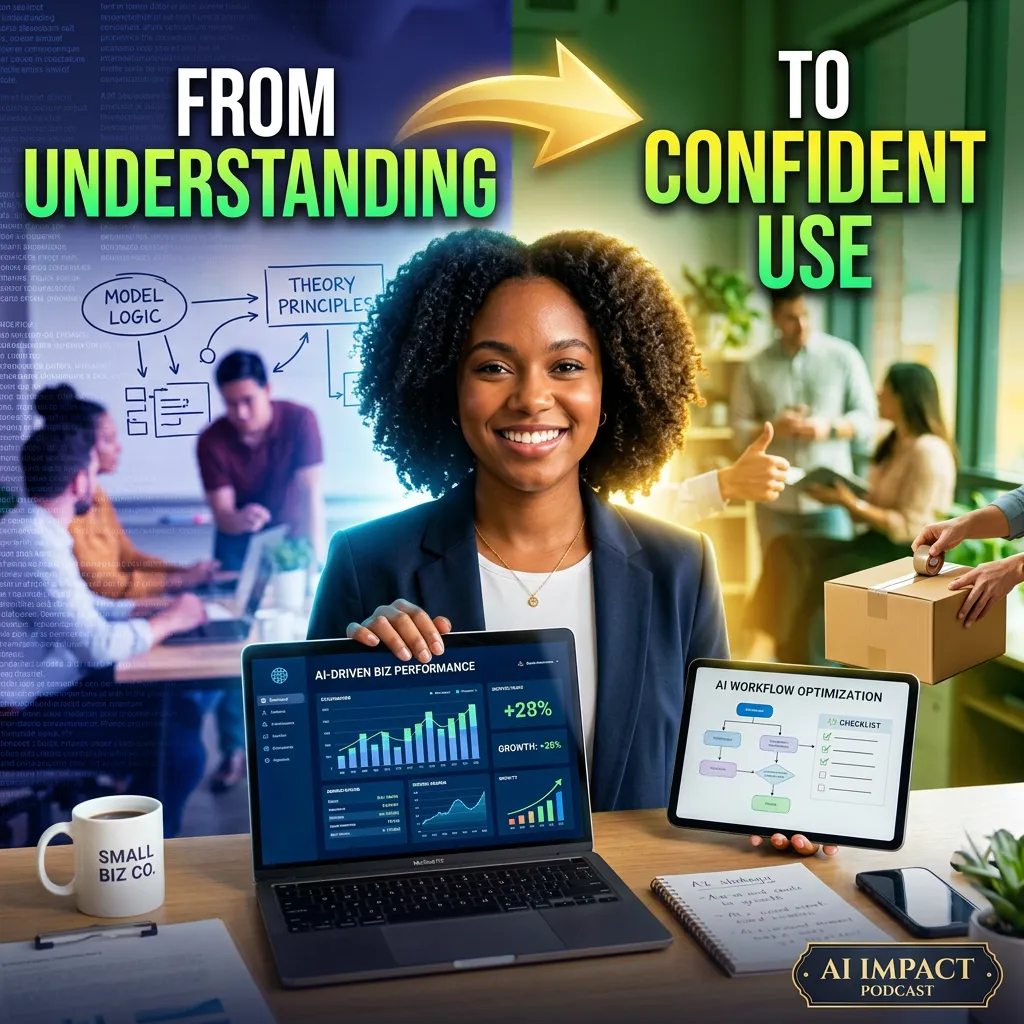
Turning AI Understanding into Confident Real-World Use

Description
This article, “Turning AI Understanding into Confident Real-World Use,” explores the gap between knowing what AI is and actually using it effectively in everyday situations. It emphasizes that real value comes not from theoretical understanding, but from consistent, intentional, and responsible application.
Summary
The article argues that while many people are aware of AI, they hesitate to use it due to uncertainty and lack of practice. It introduces the concept of becoming an “AI practitioner”—someone who uses AI practically and intentionally in daily tasks. Confidence with AI is built through repetition, not expertise, and responsible use requires maintaining human oversight and accountability. Ultimately, the ability to use AI effectively is a lasting skill that evolves with the technology.
Quick Overview
Understanding AI ≠ using AI effectively
Hesitation comes from lack of practice, not lack of intelligence
Practitioners focus on usefulness, not novelty
Confidence is built through repetition and familiarity
Responsible use requires human judgment and accountability
Intentional use makes AI reliable and valuable
Key Points
The Knowledge-Action Gap: Many people understand AI conceptually but struggle to apply it in real situations.
Practice Builds Confidence: Repeated, small uses of AI lead to familiarity and trust.
Shift to Practical Use: AI practitioners focus on solving everyday problems, not exploring features.
Intentional Use Matters: Defining when and how to use AI removes uncertainty and builds reliability.
Balanced Approach: Effective users avoid both overreliance and avoidance.
Human Responsibility: AI assists, but humans remain accountable for outcomes.
Important Details & Evidence
The article highlights a common behavioral pattern: people try AI briefly but stop due to uncertainty or fear of misuse.
It distinguishes passive understanding from active practice, emphasizing that confidence only comes from doing.
It outlines practical use cases where AI adds value:
Clarifying writing
Organizing thoughts
Brainstorming ideas
Preparing communications
It warns against two extremes:
Avoidance (falling behind)
Blind trust (loss of critical thinking)
It reinforces ethical use through:
Reviewing outputs
Revising before decisions
Staying aware of bias and context
Supporting references include research from Pew Research Center, World Economic Forum, OECD, Harvard Business Review, and Brookings Institution.
Final Takeaways
You don’t need to master AI—you need to use it regularly.
Confidence comes from consistent, intentional practice, not deep technical knowledge.
The most effective users treat AI as a practical tool, not a novelty.
Maintaining human judgment and responsibility is essential for ethical use.
Becoming an AI practitioner is a durable, future-proof skill that will remain valuable as technology evolves.
🎙️ Presented by E Internet Marketing Services, helping small businesses thrive in the age of intelligent technology.
Subscribe for more insights on AI and business transformation! https://aiforbeginners.einternetmarketingservices.com/aifbd-newsletter-subscribe
👉 Learn more about Voice AI Plus: https://einternetmarketingservices.com/voice-ai-learn-more/
💡 This podcast series is inspired by the book, AI for Beginners Demystified
Enjoy the Book Summary (PDF) HERE
Visit the Author's Page: https://ricksamara.com
Get the Book on Amazon: https://www.amazon.com/dp/B0FM47NKPX
Visit the Official Information Page: https://aiforbeginners.einternetmarketingservices.com/home
Ready to explore Galaxy AI? https://galaxy.ai/?ref=richard0z
Let's connect!
Facebook: https://www.facebook.com/eInternetMarketingServices
Website: https://einternetmarketingservices.com
👍 Like this podcast? Give it a thumbs up and share it with your network if you found it helpful!
➡️ Want to learn more? Subscribe to our channel for more AI insights, practical tips and tutorials!
💬 Share this podcast with your fellow AI enthusiasts!
